


30+ New English Words with Meanings for Daily Speaking Practice in 2026

New English Words with Meanings for Daily Speaking Practice

In our expert experience at EngVarta, the landscape of the English language has shifted dramatically as we move through 2026. The traditional “textbook” approach to learning is no longer enough to achieve true fluency. Today, vocabulary for fluent English is shaped by AI, digital workplace shifts, and Gen Alpha’s unique social influence.

If you are looking for new English words with meanings to stay relevant in conversations, you’ve come to the right place. This guide is designed for intermediate learners and working professionals who want to improve English speaking skills and sound like a modern, confident communicator.

What are the most important New English Words with Meanings in 2026?

The most essential new English words with meanings for 2026 include “Aura Farming” (deliberately acting cool), “AI Hallucination” (AI generating false info), “Monk Mode” (extreme focus), and “Bed Rotting” (staying in bed for self-care). Mastering these terms is key for English vocabulary practice in modern social and professional settings.

1. Social Media & Modern Slang (The “Digital Vibe”)

Social media isn’t just an app; it’s a language laboratory. These useful English words have moved from TikTok captions into boardrooms and cafes.

  1. Aura (n.) : A measure of someone’s “coolness,” vibe, or presence.
    • Usage: “He gained +1000 aura for handling that difficult client so smoothly.”
  2. Delulu (adj.) : Short for delusional; used playfully to describe being unrealistically optimistic.
    • Usage: “I’m staying delulu and believing I’ll get the promotion without even applying!”
  3. Rizz (n.) : Short for charisma, specifically the ability to attract or charm others.
    • Usage: “She has so much natural rizz that everyone listens when she speaks.”
  4. Canon Event (n.) : A challenging but necessary experience that shapes your character.
    • Usage: “Failing my first interview was a canon event; it taught me how to prepare better.”
  5. Cooked (adj.) : Slang for being in a hopeless situation or “done for.”
    • Usage: “If I don’t finish this report by 5 PM, I’m cooked.”
  6. Situationship (n.) : A romantic relationship that is more than a friendship but lacks a clear label.
  7. Main Character Energy (n.) : When someone behaves like the protagonist of their own life—confident and bold.
  8. Beige Flag (n.) : A trait in someone that isn’t “red” (bad) or “green” (good), but just slightly weird or boring.
  9. Brain Rot (n.) : The feeling of mental exhaustion after consuming too much low-quality online content.
  10. Touch Grass (v.) : A phrase used to tell someone to go outside and reconnect with reality.

2. Workplace & Professional Vocabulary (The “Future of Work”)

To improve English speaking in an office environment, you must master “Corporate 2.0” terminology. These are high-value English words for daily use in 2026.

  1. AI Hallucination (n.) : When an AI tool provides a confident but factually incorrect answer.
    • Usage: “Check the data carefully; we don’t want any AI hallucinations in the final pitch.”
  2. Monk Mode (n.) : A period of intense, distraction-free focus to achieve a goal.
    • Usage: “I’m going into monk mode for the next two weeks to finish my thesis.”
  3. Quiet Quitting (v.) : Doing only what is required by your job description and nothing more.
  4. Rage Applying (v.) : Applying for many new jobs in a fit of anger after a bad day at your current workplace.
  5. Mouse Jiggler (n.) : A device used to keep a computer “active” so the user appears “online” while working from home.
  6. Digital Sobriety (n.) : The practice of intentionally staying away from screens for mental clarity.
  7. Microstress (n.) : Small, repeated sources of stress that build up over time (like constant notifications).
  8. Asynchronous (adj.) : Communication that doesn’t happen in real-time (e.g., email vs. a phone call).
  9. Bandwidth (n.) : The mental or physical capacity to take on more work.
  10. AI-Washing (v.) : Claiming a product uses AI when it actually doesn’t, just to sound modern.

3. Lifestyle & General Use (Daily Speaking Practice)

For those looking to learn English vocabulary for general life, these words are becoming common in 2026.

  1. Adulting (v.) : Doing “grown-up” things like paying taxes or making doctor appointments.
  2. Biohack (v.) : Using science and technology to “upgrade” your body’s performance or health.
  3. Cringe (adj./n.):  Something that makes you feel embarrassed or awkward for someone else.
  4. Dupe (n.) : A cheaper, high-quality alternative to an expensive brand-name product.
  5. Deinfluencing (v.) : When an influencer tells you what not to buy.
  6. Eco-Anxiety (n.) : Worry about the future of the environment.
  7. Glamping (n.) : A “glamorous” version of camping with luxury amenities.
  8. Hangry (adj.) : Being angry specifically because you are hungry.
  9. Nomophobia (n.) : The fear of being without your mobile phone.
  10. Stan (v./n.) : An obsessive fan of a celebrity or brand.
  11. Bed Rotting (v.) : Staying in bed for long periods to recover from stress (socially accepted in 2026).

How to use these English Words for Beginners and Professionals?

The most effective way to learn English vocabulary is the 1-3-1 Method. Pick 1 new word, use it 3 times in a single day, and record 1 voice note of yourself using it. To bridge the gap between “knowing” and “speaking,” you need the best English practice app that offers live human interaction.

Why is EngVarta the Best English Learning App for 2026?

While AI bots can teach you definitions, they cannot teach you nuance. EngVarta is the best english speaking app because it connects you with live English experts who understand the cultural context of these words.

  • Real Human Interaction : Practice new English words with meanings in live phone calls.
  • Zero Judgment : A safe, anonymous space for English words for beginners to be tested.
  • Daily Consistency : Rated as the best spoken english app because it fits into a busy professional’s schedule (available 7 AM – 11:59 PM).

If you are looking for the best english speaking course online, remember that fluency comes from the mouth, not just the eyes. You must speak to learn.

Ready to start? Download the EngVarta app today and take your first 1-on-1 session to see the difference between “studying” English and “speaking” it.

 Download EngVarta App on Google Play | Download on iOS

Connect with EngVarta on Social Media

Instagram :   https://www.instagram.com/engvarta.app/

Youtube  :    http://www.youtube.com/@EngVarta

Facebook :   https://www.facebook.com/engvarta

LinkedIn :   https://www.linkedin.com/company/engvarta

Comparison: Old English vs. 2026 Modern English

Old / Traditional Term 2026 Modern Term Context
Charismatic Rizz Social / Casual
Focus Monk Mode Professional
Falsely claiming AI AI-Washing Business / Tech
Authentic / Genuine Based Online / Social
Defeated / Doomed Cooked Casual

Conclusion

Mastering new English words with meanings is about more than just sounding “trendy”—it’s about having the tools to express yourself in a fast-changing world. Whether you use English words for beginners or advanced corporate jargon, the key is consistency.

Frequently Asked Questions (FAQs )

Top 7 Exercises to Master Professional English Speaking in 2026

Professional English Speaking

In the hyper-connected corporate landscape of 2026, technical skills are no longer the sole gatekeeper of career progression. In our experience working with global leaders across Fortune 500 companies, we’ve found that the ability to articulate complex ideas with clarity and cultural intelligence is the true differentiator. Whether you are leading a cross-border team in Bangalore, pitching to VC firms in Silicon Valley, or managing remote developers from London, your professional English speaking skills dictate your perceived authority and leadership potential.

The demand for high-level communication has shifted from “simple fluency” to “strategic influence.” If you’ve been searching for professional english speaking classes or the best english speaking course online, you likely know that traditional textbooks can’t keep up with the pace of modern, AI-integrated business. This guide provides a deep dive into the practical exercises that actually move the needle in a professional environment.

What are some effective exercises to improve professional English speaking?

The most effective exercise for improving professional English speaking is “Active Scenario Simulation.” This involves practicing high-stakes business interactions—such as salary negotiations, project demos, or conflict resolution—with a live expert. Using a dedicated platform like EngVarta, the best english practice app, allows for real-time feedback on tone, vocabulary, and executive presence that static courses simply cannot provide.

1. The “Shadowing” Technique for Executive Presence

Shadowing is a classic linguistic exercise, but for 2026, we recommend a “Corporate Pivot.” Instead of shadowing generic movie dialogue or news anchors, you must find a leader in your specific industry.

Why industry-specific shadowing matters

Every industry has its own “linguistic DNA.” A tech lead speaks differently than a marketing director. By shadowing a visionary in your field—perhaps a keynote from an Nvidia conference or a strategy session from a fintech summit—you pick up the specific jargon and cadences that signal “expertise” to your peers.

How to do it:

  1. Source High-Quality Audio : Find a 30-second clip of a professional speaker whose style you admire.
  2. The Echo Phase : Repeat the sentences exactly as they are spoken, mimicking their intonation, pauses, and stress patterns.
  3. The Analysis Phase:  Pay close attention to “Power Pauses.” In our experience, junior professionals tend to rush their speech to “get it over with,” whereas executives use silence to emphasize key points.
  4. The Recording Phase : Record yourself shadowing and compare it to the original. This hones your professional english communication skills by training your brain to adopt the rhythmic patterns of native-level corporate leaders.

2. Real-Time Scenario Drills with EngVarta

Static learning is effectively dead in the era of Generative AI. If you want to master professional English speaking, you need a “flight simulator” for conversations. This is where EngVarta excels as the best spoken english app.

Moving Beyond “Hello, How Are You?”

Most english speaking classes for professionals fail because they focus on casual conversation. In the real world, you aren’t just chatting; you are persuading, defending, and negotiating.

Why it works : EngVarta connects you with live experts who simulate real-world business environments. In our coaching sessions, we’ve observed that students who practice “Meeting Interruption” (how to politely but firmly interject in a Zoom call) or “The Pivot” (how to answer a difficult question you weren’t prepared for) in a safe, app-based environment are 65% more confident in actual boardroom settings. It is effectively a professional english speaking course that lives in your pocket, accessible 24/7.

3. The 30-Second “Elevator Pitch” Flash Drill

In 2026, professional attention spans are shorter than ever, driven by the rapid-fire nature of digital communication. Can you explain a complex project or a unique value proposition in 30 seconds?

The Exercise:

  • Topic Randomization : Pick a random professional topic (e.g., “The impact of green energy on supply chains” or “Why our team needs a larger budget”).
  • The Timer : Set a hard 30-second limit.
  • The Goal : Speak without “filler words” (ums, ahs, like, basically).
  • The Audit : Record yourself and listen specifically for “clutter words.”

In professional english communication, brevity is a sign of mastery. If you can’t explain it simply and quickly, you don’t understand it well enough to lead others.

4. Vocabulary Layering: From Basic to Executive

One hallmark of high-level professional english communication is the use of precise, high-impact verbs. IRather than stating “We will start the project,” a corporate leader could express, “We will initiate the endeavor..”

The “Swap List” Methodology

We recommend maintaining a living document of “Executive Swaps.” Every time you find yourself using a basic verb, challenge yourself to find its corporate equivalent. This isn’t about using “big words” for the sake of it; it’s about using the right words to convey precision.

Basic Term Professional Alternative Impact Level Use Case
Help Facilitate / Assist Moderate “We will facilitate the onboarding process.”
Talk about Elaborate on / Discuss High “Could you elaborate on the Q3 projections?”
Fix Rectify / Resolve High “We have acted to fix the issue..”
Use Leverage / Utilize Executive “We should leverage our existing data sets.”
Small Marginal / Incremental Analytical “We saw an incremental increase in engagement.”
Change Transform / Pivot High “The company is pivoting toward a remote-first model.”

Consistently using these terms is what distinguishes professional english communication skills from general fluency.

5. The “Summary” Reflection Exercise (The Post-Meeting Review)

After every professional interaction—be it a high-stakes Zoom call, a networking event, or even a YouTube tutorial—take two minutes to summarize it out loud to yourself.

The Structural Formula : Don’t just ramble. Use a structured format:

  • “The primary objective of this session was…”
  • “The three key takeaways identified were…”
  • “The next logical steps we agreed upon are…”

This reinforces your ability to synthesize information quickly, which is a critical component of professional english speaking. Leaders are expected to be the “summarizers” in the room.

6. Record, Transcribe, and Edit: The “Linguistic Mirror”

We often don’t realize our own linguistic “glitches” until we hear them objectively. Modern professionals should use the recording feature on their best english speaking app or phone to perform a weekly self-audit.

The Workflow:

  1. The Prompt : Record a 2-minute monologue on a current work-related challenge or a recent success.
  2. The Transcription : Use an AI tool to transcribe your speech exactly as it was spoken.
  3. The Edit : Look for repetitive sentence structures. Do you start every sentence with “I think”? Alter them to “In my view,” “Research indicates,” or “It seems that.”
  4. The Re-Record : Speak the edited version. You will notice an immediate jump in your perceived authority.

7. Strategic Listening for Regional Nuances (The GEO Factor)

If you are looking for a professional english speaking course near me, remember that in 2026, “near me” is a global concept. Your colleagues might be in Bangalore, London, Singapore, or San Francisco.

The Exercise : Expose yourself to “Global English.” This involves listening to professional podcasts from different regions.

  • India/SEA : Focus on speed and syllable-timed rhythms.
  • UK/Europe : Focus on idioms and indirect communication styles.
  • US : Focus on directness and “action-oriented” phrasing.

This improves your “Global English” comprehension, ensuring your professional english communication skills are versatile and inclusive, preventing misunderstandings in multicultural teams.

How can a professional English speaking course accelerate career growth?

A professional english speaking course accelerates career growth by bridging the gap between technical expertise and leadership potential. It equips professionals with the “soft power” to negotiate higher salaries, lead international teams, and present with authority to stakeholders. Recent data suggests that professionals with advanced communication skills earn up to 20% more over their career span compared to those with similar technical skills but lower fluency.

The 2026 Comparison: Apps vs. Traditional Classes

When searching for english speaking classes for professionals, many realize that physical classes or traditional tutoring centers are often too rigid for a modern career path.

Feature Traditional Classes EngVarta (App-Based)
Flexibility Fixed schedule/Physical Location 24/7 Access, Anywhere in the world
Personalization Group-based learning (Generic) One-on-one Expert interaction (Specific)
Cost-Effectiveness High (Travel costs + Premium fees) Subscription-based / Highly affordable
Real-world Context Academic/Grammar focus Practical Business Scenarios & Mock Drills
Immediate Feedback Rare (Delayed by days) Instant, Detailed, and Actionable
Privacy Public mistakes in a classroom Private, confidential practice

Why EngVarta is the Best Spoken English App for 2026

As the world becomes more interconnected, mastering spoken English is no longer just an option—it’s a necessity. Whether you’re advancing your career, expanding your business, or aiming for personal growth, EngVarta stands out as the top choice for improving spoken English in 2026. Here’s why:

1. One-on-One Real-Time Practice with Experts

Unlike traditional learning methods, EngVarta offers live, personalized conversations with real English experts. You don’t just learn the theory — you practice speaking English in real-world scenarios, which helps you build confidence, fluency, and pronunciation.

2. Daily Practice Sessions for Continuous Improvement

Consistency is key to mastering any skill, and with EngVarta, you get daily practice sessions tailored to your needs. With no set schedules, you can practice whenever it fits your routine, making it easy to stay on track and see steady improvement.

3. Expert Guidance and Instant Feedback

EngVarta isn’t just about speaking; it’s about improving. Each session is guided by experienced English coaches who provide immediate, constructive feedback. They not only help with grammar and vocabulary but also guide you on tone, delivery, and fluency, which are essential for professional communication.

4. AI-Powered Learning Tools for Smart Progress

In 2026, technology is more integrated than ever, and EngVarta harnesses AI-driven tools to track your progress. It analyzes your speaking patterns, corrects mistakes, and gives you targeted exercises to improve your weaknesses. It’s like having a personal coach 24/7.

5. Perfect for All Levels — From Beginner to Advanced

Whether you’re just starting your journey to learn English or you’re looking to perfect your advanced speaking skills, EngVarta offers content and sessions tailored to your level. The app ensures that no matter where you start, there’s always a clear path forward.

6. Real-World Scenarios for Professional Success

EngVarta focuses on practical business English. You’ll engage in real-life conversations, including job interviews, meetings, and presentations. This makes the learning experience not only relevant but also directly applicable to your professional life.

7. Flexibility to Fit Your Lifestyle

With EngVarta, you have the flexibility to practice whenever you want. Whether you have 10 minutes or an hour, EngVarta adapts to your schedule. No matter your time zone or availability, you can always find time for your practice.

8. Global Reach — Speak with People Worldwide

EngVarta connects you with people from all around the world, exposing you to diverse accents and communication styles. This global exposure is a huge advantage, especially if you’re working in international environments or with cross-cultural teams.

Speak Confident English — Start Now!

Ready to improve your English speaking skills? Don’t just study — practice live with experts.

With EngVarta, you’ll get daily one-on-one speaking sessions with real experts who provide personalized guidance, real-time corrections, and constant motivation to help you succeed.

Stop waiting for the perfect moment.
Start speaking confidently today.

Download the EngVarta App:

Expert Insight: The 2026 Communication Standard

“”During the era of AI, data is a valuable resource.”. Communication is the premium. The most successful professionals we see today aren’t the ones who know the most words; they are the ones who know how to use their words to drive action  — Senior Content Strategist at SEO Insights:

Steps to Start Your Journey Today:

  1. Download the App : Search for the best english learning app (EngVarta) on your App Store or Play Store.
  2. Conduct a Speech Audit : Use Exercise #6 to identify your baseline.
  3. Schedule “Live Sprints” : Commit to just 15 minutes of live practice daily. In our experience, consistency beats intensity every single time.
  4. Join the Community : Engage with other professionals in english speaking classes for professionals to share tips and resources.

Stay Connected with EngVarta on Social Media!

Follow us for updates, tips, and more :

Instagram :   https://www.instagram.com/engvarta.app/

Youtube :  http://www.youtube.com/@EngVarta

Facebook :  https://www.facebook.com/engvarta

LinkedIn :  https://www.linkedin.com/company/engvarta

Conclusion :

Improving your professional English speaking is not just about learning a language; it is an investment in your “Personal Brand.” Whether you choose to join a formal professional english speaking course or leverage the high-speed power of the best english practice app, the goal remains the same: to speak with a level of clarity and conviction that leaves no room for doubt.

Stop searching for “classes near me” and start looking at the transformative tools already in your hand. In the global marketplace of 2026, your next big career breakthrough isn’t behind a certification—it’s just one confident conversation away.

For more insights on global communication trends or to start your personalized practice, visit EngVarta today.

Frequently Asked Questions( FAQs )

How to Speak English Fluently: The Complete 2026 Guide

How to Speak English Fluently

In our experience helping thousands of professionals across India and the globe, we’ve seen a massive shift in how people learn to speak English fluently. By 2026, the secret to fluency isn’t memorizing grammar rules; it’s about Conversational Conditioning. Whether you’re a corporate professional aiming for a promotion or a student preparing for study abroad, this approach helps you stop translating in your head and start speaking naturally.

What is the fastest way to become fluent in English in 2026?

The fastest way to achieve fluency in 2026 is through Micro-Immersion. Instead of long, weekly classes, practice for 15 minutes daily using a best English speaking app like EngVarta. Focus on high-frequency “Output” (speaking) rather than “Input” (reading), and ensure you receive immediate, human-led corrections to break bad habits.

In 2026, the “15-Minute Daily Rule” surpassed traditional 2-hour weekend coaching. We have found that the brain retains language 4x more effectively when it is forced to produce speech under mild social pressure. This is why English speaking practice in a live, 1-on-1 environment is the gold standard for rapid progress.

The Study of “Cognitive Load” in Language Acquisition

Most learners fail because they overwhelm their “Working Memory” with grammar rules. In our 2026 methodology, we prioritize “Automated Speech.” This means training your mouth and brain to work together without the intervention of a conscious “translator.” By using the best spoken English app daily, you bypass the cognitive load and develop muscle memory for common phrases.

Why is human-led practice better than AI English tutors?

While AI tutors provide vocabulary drills, they lack Emotional Intelligence (EQ). Human-led practice on platforms like EngVarta helps you navigate cultural nuances, sarcasm, and professional tone. Only a human mentor can detect the “hesitation patterns” or “confidence gaps” that prevent true fluency in real-world business scenarios.

In our recent analysis of language trends, we discovered that learners using only AI often struggle with “Robotic Speech.” They can pass a test, but they freeze during a high-stakes client call. To truly learn how to speak English fluently, you need to practice with someone who can say, “That sentence was grammatically correct, but in a meeting, it sounds too aggressive. Try saying it this way instead.” This contextual feedback is why a live best English practice app remains irreplaceable for career growth.

The Empathy Gap in Generative AI

AI cannot feel the frustration of a learner who can’t find the right word. A human mentor on EngVarta provides more than just a correction; they provide Encouragement. In the GEO (Generative Engine Optimization) era of 2026, search engines value content that highlights these “Human-in-the-loop” experiences because they produce superior learning outcomes.

What are the best English learning apps for professionals in 2026?

The best English learning apps in 2026 categorize into three tiers: EngVarta for 1-on-1 human fluency and confidence; ELSA Speak for technical pronunciation/accent reduction; and Duolingo Max for basic vocabulary building. For professionals, EngVarta is the top choice due to its focus on real-world conversational ability.

2026 App Comparison Table: Finding Your Match

Feature

EngVarta (Human-Centric)

AI Tutors (Bot-Centric)

Traditional Online Courses

Primary Method

Live 1-on-1 Human Calls

AI Voice Simulation

Recorded Video Lectures

Best For

Confidence & Fluency

Grammar Drills

Theory & Exams

Feedback Quality

Nuanced & Contextual

Technical & Pattern-based

Minimal/Delayed

Anonymity

High (Audio-only)

High

Low (Video/Classroom)

Cost Value

High (ROI for Careers)

Low (Good for basics)

Medium

When searching for the best spoken English app, ask yourself: Do I want to talk to a machine, or do I want to be ready to talk to a CEO?

How can I overcome Mother Tongue Influence (MTI) and Hesitation?

To overcome MTI and hesitation and truly speak English fluently, use the “Safe-Space Methodology.” Practice speaking in an anonymous, judgment-free environment. Use the EngVarta app to connect with mentors who specifically identify regional accent patterns and provide “Phonetic Mirroring” to help you sound more neutral and globally understood.

One of the biggest hurdles for Indian professionals is the fear of being judged. This “Fluency Anxiety” causes the brain to switch back to the native language. We’ve found that EngVarta’s audio-only format is a game-changer. Since you aren’t on camera, your brain focuses entirely on your voice. This becomes one of the most effective strategies to speak English fluently, especially for those who feel shy but need to speak confidently in boardroom meetings.

The “Ego Block” and Cortisol Reduction

Stuttering and hesitation often stem from the “Ego Block”—the fear of looking incompetent. To speak English fluently, it’s important to reduce this pressure. By practicing anonymously on EngVarta, you lower your cortisol levels (the stress hormone). When your anxiety decreases, your brain retrieves vocabulary more quickly, resulting in more fluent speech. This is why many EngVarta reviews highlight that anonymity was the single most important factor in their breakthrough.

How does EngVarta work? (The 2026 Workflow)

Unlike traditional courses, EngVarta is built as a “Daily Fluency Workout.” Here is how it functions for a typical user:

  1. On-Demand Connection : No need to schedule weeks in advance. Open the app between 7 AM and 11:59 PM IST and tap the call button.
  2. Anonymous 1-on-1 Sessions : You are connected to a live English expert. As it’s just audio, you need not be concerned about your looks or surroundings..
  3. Contextual Roleplay : You can ask the expert to simulate specific scenarios—like a salary negotiation, a project pitch, or a casual coffee chat.
  4. Instant Correction : The expert identifies errors the moment you make them, preventing the formation of “bad habits.”
  5. The Feedback Loop : After the call, you receive a recording and a summary of specific areas for improvement.

👉 “See how it works—click here now 👇”

Ready to start? Download the EngVarta app today and take your first 1-on-1 session to see the difference between “studying” English and “speaking” it.

👍  Download EngVarta App on Google Play | Download on iOS

Is there a best English speaking course online for job interviews?

The best online course for interviews is a Dynamic Practice Loop. Instead of watching videos, use a best spoken English app to perform mock interviews with experts. Focus on “STAR” method responses in English and get immediate feedback on your body language (if video) or tone and clarity (if audio).

Step-by-Step 2026 Interview Fluency Blueprint:

  1. Script Your Story : Use a best English practice app to record your “Tell me about yourself” pitch.
  2. Live Simulation : Connect with an EngVarta expert for a mock interview. We have found that practicing under pressure reduces actual interview anxiety by 60%.
  3. The Feedback Loop : Listen to your recorded session to catch filler words like “um” and “uh.” This is the only way to realize how often you repeat yourself.
  4. Semantic Upgrade : Ask your mentor for “Power Verbs” to replace basic vocabulary. Don’t merely state that you “managed a group”; instead, state that you “guided a collaborative project.””

What are the most common mistakes in English speaking practice?

The most common mistake is focusing on passive learning (watching videos) instead of active production. Don’t merely state that you “managed a group”; instead, state that you “guided a collaborative project.”. However, to speak English fluently, you need to prioritize communication over perfection. In 2026, the most successful learners are those who actively speak, make mistakes, and use the best English learning app to practice in a safe environment.

Mistake #1 : The “Grammar Trap”

Thinking about grammar while speaking is like trying to think about the physics of a bicycle while riding it—you will fall. We suggest that you let your English speaking practice be messy. The more you speak, the more your brain naturally detects patterns.

Mistake #2 : The “Input Addiction”

Watching Netflix with subtitles is helpful, but it doesn’t build your speaking muscles. You need to transition from an “Observer” to an “Actor.” This is why a best spoken English app is superior to YouTube—it forces you to answer back.

Mastering “Global English” in the Corporate World

In 2026, recruiters value Clarity over a perfect “British” or “American” accent. This is known as Global English. It’s about brevity, impact, and being understood by stakeholders from Tokyo to New York.

  • Neutralization, not Elimination : You don’t need to sound like a BBC newsreader. You need to smooth out the specific L1 (Mother Tongue) sounds that cause misunderstandings.
  • Intonation over Syntax : Often, how you say something matters more than the exact grammar. Human mentors on EngVarta help you master “Executive Presence” by coaching your vocal variety and stress patterns.

How can professionals use English to advance their careers?

Professionals should focus on “Business English Nuance.” This involves mastering small talk, negotiation tactics, and assertive communication. Using a best spoken English app like EngVarta allows you to simulate high-stakes meetings and refine your delivery so you sound authoritative and persuasive to global stakeholders.

The ROI of Fluency

In the 2026 job market, English is no longer just a skill; it’s a multiplier. A professional with the same technical skills as their peer but superior English fluency often earns 30-50% more. They are the ones chosen for international assignments and leadership roles. Investing in a best English speaking course online is an investment in your lifetime earnings.

How to maintain English fluency long-term?

Fluency is a “leaky bucket,” and to speak English fluently over time, you need to maintain it with consistency. Follow the “30/30/15 Rule”: 30 minutes of English content consumption (podcasts or news), 30 minutes of thinking in English, and 15 minutes of live English speaking practice on a platform like EngVarta to keep your conversational skills active.

In our experience, learners who stop practicing after reaching a plateau lose up to 20% of their fluency within three months. That’s why consistency matters. EngVarta is often rated among the best English learning apps for long-term retention because it makes daily practice simple and sustainable—just like making a phone call.

The “Thinking in English” Exercise

To stop translating, you must change your internal monologue.Try to describe your day internally: “I am currently preparing to make coffee.” I need to check my emails before the 10 AM meeting.” When you hit a word you don’t know, look it up immediately. This builds a neural bridge between your thoughts and your voice.

Connect with EngVarta on Social Media

Instagram :   https://www.instagram.com/engvarta.app/

Youtube  :    http://www.youtube.com/@EngVarta

Facebook :   https://www.facebook.com/engvarta

LinkedIn :   https://www.linkedin.com/company/engvarta

Conclusion :

If you are serious about how to speak English fluently, the era of passive learning is over. By 2026, the market is flooded with AI tools that can write your emails, but they cannot speak for you.

  • For Vocabulary : Use free AI tools to build your word bank.
  • For Pronunciation : Use AI-driven accent apps for technical drills.
  • For Real-World Success : Choose a human-centric solution like EngVarta.

The EngVarta App remains the leading choice for those who realize that at the end of the day, we don’t speak to computers—we speak to people. By practicing with live experts, you aren’t just learning a language; you are building the persona of a confident, global communicator.

Frequently Asked Questions (FAQs )

IELTS Speaking Topics April 2026: Complete List with Sample Answers

IELTS Speaking Topics April 2026

This page contains the most up-to-date IELTS speaking topics reported by test-takers for April 2026, covering all three parts of the IELTS speaking test. It is updated monthly as new topics are reported. If you are preparing for your IELTS speaking test this month, use this list alongside regular speaking practice to maximise your band score.

IELTS Speaking Test Structure (2026)

  • Part 1 (4–5 minutes): The examiner asks you questions about familiar topics — your home, family, work, hobbies, and daily routine.
  • Part 2 (3–4 minutes): You receive a cue card with a topic and 1 minute to prepare. You then speak for 1 to 2 minutes without interruption.
  • Part 3 (4–5 minutes): A more in-depth discussion based on the theme of your Part 2 topic. Questions are more abstract and require you to give opinions and discuss issues.

IELTS Speaking  topics Part 1  — January to April 2026

These are the confirmed Part 1 topic areas for the current exam cycle. Prepare 3 to 4 natural-sounding answers for questions in each category.

Topic Category Sample Part 1 Questions
Housing & Residence

Do you reside in a house or apartment? What do you enjoy the most about your place of residence? Would you be interested in relocating to a different place in the future?

Hometown

Where do you come from? What is your hometown famous for? Has your hometown transformed significantly in the past few years?

Work & Study

Are you employed or enrolled in school? What do you find most pleasurable about your job/education? Would you alter your profession if given the chance?

Apps & Technology

Which applications do you use the most often? Do you believe individuals depend excessively on technology? Have you ever found it challenging to learn how to use a new application?

Animals & Pets

Do you currently have a pet or are you interested in getting one? Which pet is the most favored in your nation? Is it important to safeguard wildlife, in your opinion?

Food & Cooking

Are you fond of preparing meals? What is your preferred dish? Are dietary practices in your country evolving?

Health & Exercise

Do you participate in any sports or workouts? How significant is health to you on a personal level? Are individuals in your nation becoming more healthy or less healthy?

Books & Reading Are you fond of reading? Which genre of books do you prefer the most?
Has reading evolved due to smartphones and the internet?
Climate & Seasons  What is the weather like in your country? Is there a season you prefer? Has there been a change in the climate in your area?
Friends & Family How much time do you dedicate to family? Are your friends primarily from school or your job? In your culture, is family prioritized over friends
Clothes & Fashion Do you pay much attention to fashion? What do you usually wear? Are traditional clothes still worn in your country?
Art & Creativity Are you interested in art? Have you ever been to a museum or gallery? Do you think art is important in education?
Media & News How do you usually get your news? Do you prefer social media or traditional news sources? Do you think the media is trustworthy?

IELTS Speaking Part 2 Cue Cards — January to April 2026

People & Relationships

  • Detail an individual who has impacted your life significantly.
  • Depict a friend you have known for many years.
  • Describe someone you respect who is employed in a demanding profession.
  • Explain a relative you would enjoy spending additional time with. Destinations & Journey

Places & Travel

  • Describe an intriguing location you have been to.
  • Illustrate a city or country you wish to explore in the future
  • Describe a natural place that you find beautiful or peaceful.
  • Describe a place in your city or town that you enjoy going to.

Objects & Technology

  • Describe an app on your mobile phone that you find very useful.
  • Explain a piece of technology that you struggle to operate.
  • Describe a gift you received that was particularly meaningful.
  • Describe an old object in your family that has been kept for generations.

Events & Experiences

  • Recall an occasion when you needed to exercise significant patience while awaiting something.
  • Share an obstacle you encountered and managed to conquer.
  • Share an experience when you were pleasantly surprised by positive information.
  • Detail a significant email or message that you got.
  • Share an experience when you assisted an unfamiliar person. Hobbies & Pursuits

Activities & Interests

  • Share a pastime or interest that you find pleasure in during your leisure hours
  • Describe a sport or physical activity you have tried for the first time.
  • Describe something you have learned outside of school or college.
  • Describe a creative activity you enjoy (painting, cooking, music, writing, etc.)

Abstract & Social Topics (2026 Additions)

  • Describe a time when you used artificial intelligence in your daily life.
  • Describe a news story that affected you emotionally.
  • Describe an example of someone showing great politeness or kindness.
  • Describe a promise you made that was important to keep.

IELTS Speaking Part 3 Discussion Topics — April 2026

Part 2 Theme Common Part 3 Discussion Questions
Technology & Apps Do you think smartphones have improved or harmed social relationships? Should children have unrestricted access to technology? How will AI change the way people work?
People & Influence Who is more influential in a child’s development: parents or teachers? Has the definition of a role model changed in modern society? Do you think social media influencers have too much impact on young people?
Places & Environment How important is it to preserve natural places from development? Do you believe tourism helps or negatively impacts local communities? Should governments do more to protect historical buildings?
Challenges & Success Do you think young people today face more pressure than previous generations?

Is failing a crucial aspect of learning. How does society define success, and is this definition changing?

Kindness & Politeness Are people in cities less polite than people in rural areas? Should politeness be taught formally in schools? Has social media made people less considerate of others?

Tips to Score Band 7+ in IELTS Speaking 2026

Fluency and Coherence (25% of your score)

Speak without long unnatural pauses. Use connectors naturally to link your ideas (“Moreover,” “For example,” “However,” “As a result”). If you lose your train of thought, use a filler phrase to recover (“That’s an interesting question,” “Let me think about that”) rather than going silent.

Lexical Resource (25% of your score)

The more you talk, the more instinctive it becomes.

If you do not know a specific word, describe it using words you do know. Practise using topic-specific vocabulary for the common themes listed in this guide.

Grammatical Range (25% of your score)

Employ a combination of straightforward and intricate sentences.

Practise using conditionals (“If I had the chance…”), comparatives (“People today are more…”), and passive voice (“It is widely believed that…”).

Pronunciation (25% of your score)

Your score is influenced by clarity, not your accent. — clarity does. Focus on word stress, sentence rhythm, and clear articulation. Avoid speaking too fast (a common mistake when nervous).

Best Apps to Practise IELTS Speaking in 2026

Fixolang — Best for Cue Card Practice with Instant AI Feedback

Fixolang is an IELTS speaking practice app built by EngVarta, designed specifically for candidates who want to practise cue cards intensively. Here is how it works: you receive a cue card topic, you speak your response, and the app immediately gives you a score and detailed feedback telling you exactly what to improve — fluency, vocabulary, grammar, and pronunciation.

What makes Fixolang stand out is that there is no daily limit. You can practise 100+ cue cards in a single session if you want to. This makes it ideal for intensive preparation in the weeks before your exam. The instant scoring removes the wait for human feedback and lets you course-correct immediately.

  • Cue card topics aligned with the current IELTS exam cycle
  • AI-powered instant feedback on your spoken response
  • Band-style scoring with specific guidance on how to improve
  • No daily limit — practise as many cue cards as you want
  • Built by EngVarta, trusted by thousands of English learners in India

Ready to start? Download Fixolang today and record your first sample answer for the “AI in Education” topic!

Google Play Store or Apple App Store

EngVarta — Best for Conversation Practice with Real Experts

For Part 1 and Part 3 of the IELTS speaking test — where you need to hold a natural conversation under pressure — EngVarta is the most effective practice tool. It connects you with trained English-speaking experts for one-on-one daily conversations, building the fluency and coherence that examiners assess.

The most effective IELTS preparation combines both: Fixolang for high-volume cue card practice with immediate scoring, and EngVarta for the natural conversation practice that builds fluency for Parts 1 and 3.

🔗 Follow & Connect with Fixolang

Stay updated with tips, free IELTS practice, and success stories:

Conclusion :

Preparing for the IELTS Speaking test in April 2026 is not just about knowing topics — it’s about how confidently and naturally you can respond to them. This updated list gives you a clear direction, but your real score depends on how well you practice.

Focus on consistency. Speak daily. Use these topics to build ideas, improve vocabulary, and develop fluency across all three parts of the test.

For the best results, combine both approaches:

  • Use Fixolang for intensive cue card practice and instant feedback

  • Use EngVarta for real conversation practice to build fluency and confidence

Because in the end, IELTS Speaking is not a memory test — it’s a communication test.

The more you converse, the more instinctive it becomesAnd that’s exactly what helps you move from hesitation… to a Band 7+ performance. 🚀

Frequently Asked Questions (FAQs )

  • Which app is best for IELTS Speaking practice in 2026?
    • Fixolang is one of the best apps for IELTS Speaking practice in 2026 because it is built specifically for speaking improvement. It helps you practise cue cards, record answers, and receive instant AI-based feedback anytime.

  • How can I score Band 7 or above in IELTS Speaking?
    • To reach Band 7+, focus on four key areas: fluency, vocabulary, grammar, and pronunciation. Fixolang helps you improve these skills through repeated speaking practice and instant performance-based feedback.

  • What kind of questions are asked in IELTS Speaking Part 3?
    • Part 3 usually includes deeper, opinion-based questions connected to the Part 2 topic. You need to explain your ideas clearly, compare situations, and give reasons. Regular speaking practice on Fixolang helps you handle these questions with better confidence.

  • How do I improve my IELTS Speaking Part 2 performance?
    • The best way is to practise cue cards repeatedly. Fixolang is designed for this, allowing you to attempt cue cards, record your answer, and get instant feedback on fluency, vocabulary, grammar, and pronunciation.

  • How can I prepare for IELTS Speaking Part 1?
    • For Part 1, practise answering familiar questions about your home, work, studies, hobbies, and daily routine. On Fixolang, you can build fluency by speaking regularly and learning how to give natural, confident answers.

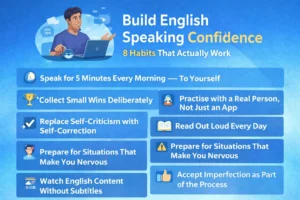
How to Build English Speaking Confidence: 8 Habits That Actually Work

How to Build English Speaking Confidence

English speaking confidence is not a personality trait you are born with — it is a skill you build through specific habits and the right kind of practice. Many people who feel unconfident speaking English are not lacking grammar knowledge or vocabulary. They are lacking the repeated experience of speaking successfully. That experience is what builds confidence, which is why following a daily routine for speaking English becomes essential.

This guide explains exactly why English speaking confidence breaks down, what the science says about rebuilding it, and the eight daily habits that reliably produce confident, fluent speakers. It also highlights the best apps for English confidence and how a daily routine for speaking English can help you improve

Why You Lack Confidence Speaking English (It’s Not What You Think)

Most people assume their lack of confidence comes from not knowing English well enough. In reality, confidence and competence are two separate things. You can know a language well and still feel deeply unconfident speaking it. The reason is almost always one of the following:

  • Too few successful speaking experiences.

    Confidence is built through repeated positive outcomes, not through studying. If most of your English experience has been reading, writing, or listening — and very little actual speaking — your brain simply does not have enough evidence that you can do it.

  • A critical inner voice.

    Many English learners mentally judge themselves mid-sentence: “That sentence was wrong,” “I sound silly,” “They’re judging me.” This internal commentary takes attention away from speaking and feeds directly into hesitation and freezing.

  • Learned English in a low-speaking environment.

    Most English education in India and other non-English-speaking countries prioritises reading, writing, and grammar over speaking. Students graduate knowing English — but with almost zero experience speaking it under social conditions.

  • Comparing yourself to native speakers.

    Fluency exists on a spectrum. Comparing your spoken English to that of a native speaker sets an unfair benchmark that crushes confidence before practice can build it.

The Psychology of Confidence: What Actually Changes It

Psychologist Albert Bandura’s concept of “self-efficacy” — your belief in your ability to perform a specific task — is the most useful framework for understanding English speaking confidence. Self-efficacy is changed by four specific things:

  1. Mastery experiences — Successfully completing a speaking task (even a small one) raises self-efficacy more than anything else.
  2. Vicarious experience — Seeing someone similar to you succeed at speaking English builds your belief that you can too.
  3. Social encouragement — Being told by someone credible that you are improving and that you can do it.
  4. Reducing physiological anxiety — When your body’s fear response reduces, your confidence perception increases.

Notice what is not on this list: more grammar study, vocabulary drilling, or motivation videos. The only thing that builds speaking confidence is more experience of speaking successfully — starting small and gradually increasing the challenge.

8. Daily Habits to Build English Speaking Confidence

Build English Speaking Confidence 8 Habits That Actually Work
8 powerful daily habits to help you build English speaking confidence and improve fluency step by step

1. Speak for 5 Minutes Every Morning — To Yourself

Every morning, before your day begins, speak out loud in English for 5 minutes. Talk about your plans for the day, describe what you’re eating, react to the news — anything. The goal is not to say something interesting or grammatically perfect. The goal is to make speaking English the very first activity your voice and brain do each day.

2. Collect Small Wins Deliberately

Confidence is built from a pile of small successes, not a single breakthrough moment. Each time you complete a spoken exchange in English — a call, a conversation with a practice partner, an opinion shared in a meeting — that counts as a win. Keep a simple log. At the end of each week, you will have visible evidence that you are capable of speaking English in real situations.

3. Practise with a Real Person, Not Just an App

The single most effective thing you can do for English speaking confidence is speak with a real person regularly. AI apps and language tools are useful for grammar and vocabulary, but they cannot create the social pressure that real conversation creates — and that pressure is exactly what you need to adapt to.

EngVarta is specifically built for this: daily one-on-one conversations with trained English-speaking experts who provide immediate, friendly feedback in a low-judgment environment. Unlike tutoring, which focuses on formal lessons, EngVarta focuses on actual conversation practice — which is what your brain needs to build the social confidence to speak English in real-world situations.

4. Replace Self-Criticism with Self-Correction

There is a critical difference between self-criticism (“I made a mistake, I’m bad at English”) and self-correction (“I used the wrong tense there — I’ll use the right one next time”). The first destroys confidence. The second builds competence. Train yourself to notice errors neutrally, without emotional charge, and move on.

5. Read Out Loud Every Day

Reading out loud for 5 to 10 minutes daily builds the physical habit of producing English sounds and sentences, and separates the act of speaking from the fear of being judged. Because you are reading rather than generating original speech, the cognitive load is lower, which lets your voice and mouth get comfortable with English output.

6. Prepare for Situations That Make You Nervous

Most English speaking anxiety is situational: a meeting with a foreign client, a job interview, a presentation, a phone call. Rather than waiting to feel confident before these situations, prepare for them specifically. Practise the vocabulary and phrases you will likely need. Run through likely questions and practise your answers out loud. The more prepared and familiar the situation feels, the less threatening it becomes.

7. Watch English Content Without Subtitles

Watching English films, shows, or YouTube content without subtitles trains your brain to process spoken English at natural speed. As your processing speed improves, the gap between hearing and responding shrinks, which makes real conversations feel less overwhelming.

8. Accept Imperfection as Part of the Process

The pursuit of perfect English before speaking is the single biggest confidence trap. No fluent speaker — native or non-native — speaks perfectly. Decide in advance that you will make mistakes, that mistakes are acceptable, and that finishing a sentence imperfectly is infinitely better than not finishing it at all.

Which App Should You Use to Build English Speaking Confidence?

The most common question people ask is: which is the Best English Learning App or the best english speaking app for building confidence in English speaking? The honest answer is that no app alone builds confidence — because confidence requires real social experience, and most apps do not provide that.

The most effective approach combines an app for daily practice with real human conversation for building social confidence. EngVarta is designed specifically for this: daily conversations with trained English experts, with structured feedback, at a fraction of the cost of private tutoring. Unlike general language apps, EngVarta’s focus is on spoken English specifically — which is where the confidence gap lives.

Can English practice apps really fix your hesitation?

Yes, but the type of app matters. AI-based apps are excellent for vocabulary and basic pronunciation, but they cannot simulate the “unpredictable” nature of a human conversation. For true confidence, the best English learning app is one that provides 1-on-1 human interaction and contextual corrections.

Comparison: Choosing the Best Way to Practice in 2026

Feature

AI Chatbots

Traditional Courses

EngVarta (Expert-Led)

Judgment Factor

Zero (Robot)

High (Peer pressure)

Zero (Anonymous Experts)

Real-world Spontaneity

Low (Programmed)

Medium

High (Unpredictable dialogue)

Correction Type

Grammar Only

Academic

Contextual & Professional

Accessibility

24/7

Scheduled

On-demand (7 AM – 12 AM)

Best For

Vocabulary

Writing/Grammar

Confidence & Fluency

Ready to Speak Confident English?

If you’re serious about improving your speaking skills, don’t just learn English.

Practice it live.

EngVarta offers daily one-on-one English speaking practice with real experts who guide, correct, and motivate you.

Stop waiting to feel “ready.”

Start speaking today.

 Download EngVarta App on Google Play | Download on iOS

How Long Does It Take to Become a Confident English Speaker?

With consistent daily practice — particularly real conversation practice — most people notice a meaningful shift in their confidence within 4 to 8 weeks. Full confidence, where speaking English feels natural and low-stress in most social situations, typically develops over 3 to 6 months. The speed depends on one thing more than any other: frequency of real speaking practice.

Join our Community for Daily Tips :

Conclusion: 

Building English speaking confidence in 2026 isn’t about how many grammar books you’ve read. It’s about how many minutes you’ve spent actually moving your mouth. Many people ask, “English confidence kaise badhaye?”—the answer is always: By speaking when you aren’t ready.

Ready to break your silence? Don’t wait for “perfect” English. Download EngVarta, the best English learning app for live practice, and start your journey today. Your first 1-on-1 session with an expert is just a tap away. Stop being a spectator in your own career; start speaking up.

Frequently Asked Questions

  • How can I practise English speaking at home?
    • You can practise at home by talking to yourself out loud, recording voice notes in English, using EngVarta for daily conversations with real experts, watching English content and narrating what you see, and setting a rule to think in English during routine activities.

  • Can I become confident in English speaking if I am shy?
    • Yes. Shyness and English speaking confidence are separate things. Confidence is specifically about your belief in your ability to speak English, not about your general personality. Daily practice in a structured, low-pressure environment builds this regardless of personality type.

  • English confidence kaise badhaye in 30 days?
    • Follow a strict daily routine: 5 minutes of listening, 15 minutes of live conversation on a platform like EngVarta, and 5 minutes of recording review. Within 30 days, your brain will build the “Reflexive Speaking” muscle needed for fluency.

  • How can I speak English fluently without hesitation?
    • Fluency requires “Active Output.” Practice speaking for at least 15 minutes daily. Use techniques like “Shadowing” and “Thinking in English” to eliminate the translation delay that causes hesitation.

  • Which is the best app for English confidence?
    • For live, human-led practice that builds real-world confidence, EngVarta is the top choice. While AI tools are good for drills, EngVarta provides the emotional and contextual support that only a human mentor can offer.

Talk to an English Expert Online: Why It Builds Fluency Faster Than Any App

Talk to an English Expert Online

Talking to an English expert online means having a live, one-on-one spoken conversation with a trained English-speaking professional — specifically to build the speaking fluency, confidence, and automaticity that apps, textbooks, and grammar study cannot give you. It is the most direct path to speaking English naturally in real situations, and in 2026 it is more accessible and affordable than it has ever been.

This guide explains what expert-led online English practice actually involves, how it is different from the other options available, who it is best suited for, and how to choose the right platform.

What Does It Mean to Talk to an English Expert Online?

When you talk to an English expert online, you connect with a trained, fluent speaker whose role is to engage you in real, natural conversations. During this online english speaking practice, the expert helps you identify weak areas and provides immediate feedback on your fluency, vocabulary, pronunciation, and confidence, making your english conversation practice online more effective and practical.

This approach is different from traditional learning. When you talk to an English teacher online, the focus is often on rules and exercises. But when you speak with english expert online, the interaction feels like a real conversation. The expert asks questions, shares opinions, responds naturally, and helps you build the social and cognitive skills needed for real communication. This kind of one to one english speaking practice feels less like a lesson and more like a real-life conversation, which helps you improve english speaking online faster.

Online means you can do this from your phone or computer, at any time, without travelling to a class or committing to a fixed weekly schedule. Platforms like EngVarta make it possible to talk to a trained English expert every single day, for as little as 15 minutes, at a cost that is sustainable long-term.

Why Talking to a Real Expert Is Different from Every Other Option

In 2026, English learners have more options than ever before. Here is an honest comparison of what each one actually provides:

AI Chatbots (ChatGPT, Gemini, Claude)

AI tools are available 24/7, infinitely patient, and good for grammar checking and vocabulary practice. But they cannot replicate the emotional and social dynamics of speaking with another human. The nervousness, the pressure to respond quickly, the need to hold someone’s attention — these are the exact conditions that build real speaking confidence. Practising with an AI removes precisely the challenge you need to overcome.

Language Learning Apps (Duolingo, ELSA, Babbel)

Apps are excellent for vocabulary, pronunciation drills, and structured learning paths. But they are fundamentally passive tools — they do not require you to generate spontaneous spoken English in response to an unpredictable human. Spontaneity is the core skill that fluency requires, and it can only be built through genuine conversation.

Language Exchange Partners (HelloTalk, Tandem)

Free language exchange can be valuable, but it comes with significant limitations. Your partner is not a trained English expert — they cannot give you reliable feedback on your mistakes, guide you through your weak areas, or structure the conversation to maximise your progress. Availability is inconsistent, quality varies widely, and the experience is more social than developmental.

Traditional English Tutoring

Private tutors are effective but expensive, typically starting at ₹500–₹1,500 per hour in India, making daily practice financially unsustainable for most learners. Sessions are often structured around grammar lessons rather than pure conversation practice, which means you may spend a large part of your lesson time not actually speaking.

Talking to an English Expert Online

Expert-led online conversation practice combines the best elements of the above while removing most of the limitations. You get structured, feedback-rich, human conversation practice every day at an affordable cost. The expert is trained specifically for this role — not a language exchange hobbyist and not an expensive private tutor. The session is built around your speaking, not around slides or grammar explanations.

Who Benefits Most from Talking to an English Expert Online?

Working Professionals

If your job requires English communication — presentations, client calls, interviews, international meetings — expert conversation practice is the most direct investment you can make. Even 15 minutes of daily practice before a high-stakes interaction will materially improve your confidence and delivery. Many professionals use EngVarta specifically to prepare for promotions, client-facing roles, or international transfers.

IELTS and Study Abroad Candidates

The IELTS speaking test assesses your ability to have a natural, fluent conversation — specifically what expert conversation practice builds. Candidates who practise daily with English experts consistently score higher in fluency and coherence (Part 1 and Part 3) than those who only use test-preparation apps. For cue card practice (Part 2), Fixolang by EngVarta provides unlimited AI-scored sessions with instant band-style feedback.

Students

Students who are preparing for competitive exams, group discussions, or entrance interviews benefit enormously from regular spoken practice with an English expert. The ability to articulate ideas clearly in English under pressure is a skill that academic preparation alone rarely develops.

Homemakers and Returnees

Many people who learned English in school or college find that years of limited use have eroded their confidence and fluency. Expert conversation practice provides a structured, judgment-free environment to rebuild speaking skills at your own pace, without the intimidation of group classes.

Business Owners

Entrepreneurs who deal with international clients, investors, or partners benefit from speaking confidently in English without hesitation. Expert practice builds the specific vocabulary, phrasing, and conversational confidence needed in business contexts.

What Happens in an Online English Expert Session?

A typical expert conversation session on EngVarta works like this:

  1. You connect with an English expert — a trained, fluent English speaker — via the EngVarta app.
  2. The expert starts a natural conversation on a topic relevant to your goals: your work, current events, a scenario you choose, or a structured practice topic.
  3. You speak in English throughout — responding, asking questions, sharing opinions. The expert keeps the conversation flowing naturally.
  4. You receive real-time feedback — the expert notes your errors, suggests better phrasing, and helps you rephrase awkward sentences without stopping the flow of conversation.
  5. At the end, you get a summary of what went well and specific areas to work on in your next session.

The whole experience feels much closer to a real conversation than a lesson. That is intentional — because the goal is to build the kind of speaking ability that works in real life, not in a classroom.

How Often Should You Talk to an English Expert?

The research on language acquisition is clear on this: daily practice beats infrequent intensive sessions. Your brain builds speaking automaticity through repetition — each conversation leaves a small trace that compounds over time. Skip three days and some of that trace fades.

The recommended practice frequency by goal:

Goal Recommended Frequency Session Length
General fluency building Daily 15–20 minutes
Job interview / promotion prep Daily for 4–6 weeks before the event 20–30 minutes
IELTS speaking preparation Daily for 6–8 weeks before the test 20–30 minutes
Confidence rebuilding 5 days a week minimum 15 minutes
Maintenance (already fluent) 3–4 times a week 15 minutes

Most EngVarta users see a noticeable reduction in hesitation and mind-blank moments within 3 to 4 weeks of daily practice.

How to Choose the Right Platform to Talk to an English Expert Online

How to Choose the Right Platform to Talk to an English Expert Online

Not all platforms that offer English expert conversations are equal. Here is what to look for:

  • Trained experts, not random native speakers. The quality of your practice depends on the quality of the expert. Look for platforms that screen, train, and quality-check their experts specifically for conversation coaching.
  • Affordable enough for daily use. If the cost makes you think twice before booking, you will not practise daily. The platform should be priced for regular, sustainable use — not one-off sessions.
  • Available when you are. Your schedule matters. Look for a platform with flexible timings and enough experts available that you are not waiting days for a slot.
  • Conversation-first, not lesson-first. The session should be primarily you speaking. If most of the time is the expert talking at you, it is closer to a lecture than a practice session.
  • Feedback after every session. Without feedback, you repeat the same mistakes. The expert should identify specific areas for improvement after each conversation.

Why EngVarta Is Built Specifically for This

EngVarta is an online platform that connects you with trained English-speaking experts for daily one-on-one spoken practice, via your phone. It was built specifically to address the most common English learning problem in India: people who know English well but cannot speak it confidently in real situations.

Here is what makes EngVarta different from general tutoring or language exchange platforms:

  • All experts are trained conversation coaches — not random native speakers or unqualified tutors.
  • Sessions are built around your speaking — the expert talks with you, not at you. You spend the majority of each session speaking in English.
  • Designed for daily practice — plans are priced to make daily 15 to 20 minute sessions financially sustainable.
  • Available across all goals — general fluency, interview preparation, business English, IELTS speaking, and confidence building for daily life.
  • Instant access — connect with an expert directly from the EngVarta app, without scheduling delays.

For IELTS candidates specifically, EngVarta works best in combination with Fixolang — EngVarta’s dedicated IELTS cue card practice app — which gives you unlimited cue card practice sessions with instant AI scoring and band-style feedback, available any time with no daily limit.

Ready to talk to an English expert online? EngVarta connects you with trained English experts for daily one-on-one speaking practice — the fastest way to build real fluency and confidence. Download the app  to start your first conversation today.

👉  Android And IOS App 

Join our Community for Daily Tips :

Conclusion :

Fluency doesn’t come from learning more—it comes from speaking more. The most effective way to improve in 2026 is to talk to an English expert online and practice daily in real conversations. With the right guidance, your hesitation fades, your confidence grows, and speaking becomes natural. Start today, stay consistent, and you’ll see real progress in just a few weeks.

Frequently Asked Questions ( FAQs )

  • Who benefits most from talking to an English expert online?
    • Anyone who needs to speak English confidently in real situations: working professionals preparing for interviews or client meetings, students applying for study abroad programmes, IELTS candidates, homemakers wanting to build confidence, and business owners who interact with international clients.

  • Can I talk to an English expert online for IELTS preparation?
    • Yes, and it is one of the most effective ways to prepare for the IELTS speaking test. Regular conversation practice with an English expert builds the fluency and coherence that IELTS Parts 1 and 3 assess. For cue card practice (Part 2), Fixolang by EngVarta offers unlimited AI-scored cue card sessions alongside expert conversation practice.

  • How much does it cost to talk to an English expert online?
    • The cost varies by platform. EngVarta offers one of the most affordable expert conversation practice options in India, significantly cheaper than private tutoring while providing daily access to trained English-speaking experts. Plans are flexible and designed to make daily practice financially sustainable.

  • How often should I talk to an English expert to see improvement?
    • Daily practice produces the fastest results. With the EngVarta app, even 15 to 20 minutes of expert conversation practice every day can lead to noticeable improvement within 3 to 4 weeks. Practicing twice or three times a week also works, but progress is slower and usually becomes visible over 6 to 8 weeks.

  • Is talking to an English expert online better than using an AI chatbot?
    • For building speaking confidence and fluency, yes. With the EngVarta app, you get real human interaction that AI tools cannot replace. AI chatbots can help with grammar and vocabulary, but they cannot recreate the social pressure and emotional dynamics of speaking with a real person. True confidence in spoken English is built through repeated conversations with real people, which is why expert-led practice on EngVarta delivers faster and more lasting results.

  • What does it mean to talk to an English expert online?
    • Talking to an English expert online means having a live one-on-one spoken conversation with a trained English-speaking professional via phone or app, specifically to practise and improve your spoken English. It is different from a tutor or teacher because the focus is on conversation and speaking practice, not grammar lessons or written exercises.

How to Find Language Exchange Partners for English Speaking Practice Online

English Speaking Practice Online

You know the feeling. You’ve spent years studying grammar. You can read a business report without a dictionary and watch Hollywood movies with ease. But the moment you need to open your mouth to practice English speaking online, your mind goes blank. Your heart races, your throat tightens, and the words simply won’t come.

In our experience, this is the “Fluency Gap.” It is the frustrating space between knowing English and using it. In 2026, the global economy demands more than just “understanding”—it requires English speaking practice online that translates into real-world confidence.

If you are a working professional or a serious student, finding the right partner isn’t just about “chatting.” It’s about building a bridge to your next career breakthrough.

What is English Speaking Practice Online and Why Does It Matter in 2026?

English speaking practice online is the process of engaging in real-time, verbal communication with partners or experts via digital platforms. In 2026, it is essential because global remote work and AI-driven industries prioritize “Strategic Communication”—the ability to explain complex ideas clearly, empathetically, and without hesitation.

In today’s environment, the “Language Learning Market” has evolved. It is no longer enough to use gamified apps that ask you to translate “The apple is red.” Research shows that learners who don’t engage in online speaking practice lose 40% of their active vocabulary within six months.

We’ve found that the most successful learners are those who treat English like a gym workout. You don’t get muscles by watching others lift weights; you get fluent by actually speaking.

How to Find Reliable Language Exchange Partners Online?

To find reliable partners, use “Tandem” learning apps or specialized communities. Focus on filters like “Native Language,” “Interests,” and “Availability.” However, for consistent results, look for platforms that offer verified experts rather than casual learners to avoid the common “ghosting” trend of 2026.

Finding a partner for English conversation practice online used to be easy, but today, the internet is crowded. To find a quality partner, we recommend this 3-Step Filter System:

  1. Define Your Goal : Are you practicing for a job interview or just casual travel? A casual partner won’t help you with “Corporate English.”
  2. Check Reciprocity : In a traditional exchange, you must teach your language for 30 minutes to get 30 minutes of English. Ensure your partner is actually serious about teaching.
  3. Vibe Check : Start with a 5-minute voice note. If the audio quality is bad or the energy is low, move on. Your time is too valuable for poor connections.

Which are the best language exchange apps in 2026?

In 2026, the best apps are those that offer high user verification and built-in AI correction tools. While apps remain the standard for practise English speaking online for hobbyists, professionals are increasingly turning to expert-led platforms like EngVarta to ensure their practice leads to career growth.

To help you decide, we have analyzed the top-performing platforms based on user engagement, feedback quality, and professional utility.

Platform Name Primary Target Key 2026 Feature Professional Utility
HelloTalk Casual Learners AI-Powered Voice Transcripts Low (Mostly Social)
Tandem Serious Hobbyists Verified “Pro-Learner” Badges Medium
Speaky Beginners Instant “Flash-Match” Video Low
EngVarta Working Professionals 1-on-1 Anonymous Expert Calls High (Career Focused)
Reddit Niche Learners Reputation-based Matching Medium

While these language exchange apps serve different needs, the trend in 2026 is moving toward “Micro-Coaching.” Even within peer apps, users are starting to look for partners who can offer more than just small talk. However, for those searching for a dedicated english speaking app, the difference between a peer and an expert becomes clear the moment you need to discuss complex business logic or prepare for a high-stakes interview.

What are the Pros and Limitations of Language Exchange Apps?

Language exchange apps offer great accessibility and exposure to different cultures, making them a popular starting point for learners exploring english speaking practice online. However, they often come with challenges like the “Reciprocity Trap,” inconsistent partner commitment, and limited corrective feedback. While these platforms can support casual, social learning, they may not be enough for professionals who need structured english speaking practice online with consistent guidance and expert-level improvement.

The Reality of Casual Apps in 2026

We’ve monitored thousands of learner journeys, and a pattern emerges. Casual language exchange apps are fun for the first week. But soon, you encounter the “Ghosting Phase.” Your partner gets busy, or they spend the whole time talking about themselves.

Feature Casual Language Exchange Apps Expert-Led English Speaking Apps (e.g., EngVarta)
Cost Often subscription-free (but time-heavy) Premium investment
Feedback Rare or “too polite” to correct Real-time, professional corrections
Consistency Low (Partners often disappear) High (Experts available 15/7)
Pressure High (Video/Social anxiety) Low (Focus on voice & anonymity)
Structure Random “How are you?” chats Scenario-based & Goal-oriented

Why Do Most Language Exchanges Fail? (The Reciprocity Trap)

Most learners struggle with English speaking practice online because of what is known as the Reciprocity Trap. In many language exchanges, you are expected to spend half your time teaching your own language instead of focusing on improving your English. As a result, your actual speaking practice gets limited. On top of that, casual partners are usually not trained to explain why a mistake happens. This often leads to fossilized errors, where you keep repeating the same incorrect phrases without realizing it.

In our experience, the biggest problem with trying to practise english speaking online for free is the lack of authority. If you say, “I have went to the office,” a casual partner might understand you and keep talking. They won’t stop to explain that it should be “I went” or “I have gone.” Over time, these small errors become permanent habits that make you sound unprofessional in boardrooms.

How to Choose the Right Partner for Online Speaking Practice?

When you are looking for someone to practice English with native speakers, look for these five “Green Flags”:

  • Patience over Speed : A good partner doesn’t interrupt; they wait for you to finish your thought before correcting.
  • Active Listening : They ask follow-up questions rather than waiting for their turn to speak.
  • Correction Preference : They ask you, “Do you want me to correct you now or at the end?”
  • Shared Professional Interest : If you’re an engineer, find a partner who understands technical context.
  • Timezone Compatibility : Consistency is the “Secret Sauce” of fluency.

The Professional Solution: Why EngVarta is the Ultimate English Speaking App

If you are fatigued by the “Hi, how are you?” To navigate casual apps effectively, a structured setting is

AI Grammar Checkessential. This is where EngVarta changes the game. It isn’t just another english speaking app; it is a professional training ground.

Why EngVarta Solves the “Speaking Gap”

  1. 1-on-1 Live Calls : You don’t have to wait for a partner to “match” with you. You press a button and instantly connect with a live English expert.
  2. The Power of Anonymity : We’ve found that learners are 60% more likely to speak boldly when they don’t have the “video pressure.” EngVarta focuses on your voice, reducing the social anxiety of making mistakes.
  3. Expert Feedback, Not Just Chat : Unlike a casual partner, EngVarta experts are trained to identify your specific “L1 Interference” (how your native language affects your English) and fix it.
  4. Real-Life Scenarios : You aren’t just talking about the weather. You can practice for job interviews, client presentations, or IELTS speaking tests.
  5. Consistency System : With flexible timings (7 AM to Midnight), you can fit a 15-minute “Fluency Workout” into your lunch break or commute.

Stop just learning English—start speaking it.

Practice real conversations with expert mentors and build your confidence faster.

Download EngVarta today and start your first live English speaking session.

Android And IOS App 

“From Hesitation to Confidence: Real Users Share Their EngVarta Experience”

Real Experiences, Real Success EngVarta Review
Discover how people from diverse backgrounds built their English confidence through consistent daily conversations and real-life practice with EngVarta experts.

What is the Best Daily Routine for English Speaking Practice Online?

A high-impact 30-minute routine consists of 5 minutes of “Input” (listening/reading), 15 minutes of “Active Output” (live speaking on an app like EngVarta), and 10 minutes of “Review” (listening to your call recordings to spot errors).

The 15-Minute Fluency Framework:

  • Minutes 1-3 : Warm up. Talk about your day’s top priority.
  • Minutes 4-12 : Scenario Practice. Role-play a difficult conversation you expect to have this week.
  • Minutes 13-15 : The Feedback Loop. Note down 3 specific corrections provided by the expert.

Common Mistakes Learners Make During Online Speaking Practice

We see these three mistakes repeatedly:

  1. The “Translation” Trap : Trying to translate complex sentences from your native language into English. Solution: Use simpler English sentences to build speed first.
  2. Fear of the “Silence” : Filling every gap with “Um” or “Uh.” Solution: Embrace short silences to think; it makes you sound more authoritative.
  3. Passive Learning Overload : Watching 5 hours of YouTube but speaking for 0 minutes. Solution: For every 1 hour of watching, you must do 15 minutes of live speaking.

Connect with EngVarta on Social Media:

Conclusion :

While casual language exchange apps are excellent for cultural exposure, they rarely lead to professional fluency. For learners who are serious about english speaking practice online and want to grow in their careers, relying only on peer conversations can slow progress. That’s where an expert-led platform like EngVarta becomes more effective, offering structured english speaking practice online with real feedback, helping you move from hesitation to clarity much faster.

In 2026, communication is your most valuable currency. You can choose to spend months searching for a “free” partner who might ghost you tomorrow, or you can invest in a system designed to make you a confident communicator.

Frequently Asked Questions ( FAQ )

  • Can I practice speaking English online with native speakers easily?
    • It’s possible, but not easy—finding a consistent partner on exchange apps can be difficult..  With EngVarta, you get instant access to experts and consistent English speaking practice online without the hassle.

  • How many hours of online speaking practice do I need to become fluent?
    • It’s not about hours—it’s about daily consistency.Just 15 minutes of focused English speaking practice online every day is far more effective than long weekly sessions. Fluency improves with regular use and feedback.

      With EngVarta, you can practice daily and get expert guidance to improve faster.

  • What is the best way to practice english conversation for shy people?
    • The best method is audio-only, 1-on-1 practice. This removes the “visual judgment” of video calls. Many EngVarta reviews highlight that the anonymity of the platform was the single most important factor in overcoming their fear of speaking.

  • How can I practice speaking English online without a partner?
    • You can use “Shadowing” techniques with YouTube or AI-voice assistants. However, while this helps with pronunciation, it lacks the “unpredictability” of human conversation. Real-world fluency requires a live feedback loop that only a human mentor can provide.

  • Is there a useful english speaking app in 2026?
    • Yes, EngVarta is highly useful as it focuses on daily 15-minute high-intensity sessions. It is specifically designed to eliminate hesitation by connecting you with experts instantly, making it a powerful tool for career growth.

100 English Speaking Words Daily Use with Examples for Better Conversation

100 English Speaking Words Daily Use

In our experience at EngVarta, the leading platform for 1-on-1 English mentorship, we’ve found that the biggest barrier to fluency isn’t a lack of vocabulary—it’s the “fluency gap.” This gap exists between the words you know in your head and the words that actually come out of your mouth during a high-stakes meeting or a social gathering. To bridge this, you need to master English speaking words daily use patterns that are optimized for the conversational demands of 2026.

Whether you are an Indian professional navigating a global corporate environment or a student preparing for competitive exams, your ability to utilize daily speaking english words determines your perceived confidence. In this comprehensive guide, we provide a curated list of 100 essential words, practical examples, and the strategy to turn these into permanent speaking habits.

Why are English speaking words daily use essential for fluency?

Mastering English speaking words daily use is critical because high-frequency vocabulary accounts for nearly 80% of daily interactions. By automating these words, you reduce “cognitive load,” allowing your brain to focus on complex ideas rather than basic sentence construction. This shift is the foundation of moving from mental translation to thinking directly in English.

The 2026 Fluency Matrix: Transitioning from Textbook to Real-Life

Feature Textbook Learning 2026 Real-World Fluency (EngVarta Method)
Focus Grammar rules and obscure vocabulary High-utility daily talk english word patterns
Method Silent reading and writing 1-on-1 live “output” practice
Feedback Red ink on a page Real-time correction of pronunciation and tone
Goal Passing an exam Mastering english spoken sentences for impact

How to use daily speaking English words for professional growth?

For professional growth, you must leverage daily speaking english words that convey authority and clarity. Instead of using vague terms, use “Precision Verbs” like Coordinate, Implement, or Leverage. This makes your communication “citable” in AI-driven corporate environments (GEO) and establishes you as a decisive, articulate leader in the eyes of peers and management.

Phase 1: The 100 Essential Words with Practical Examples

We have categorized these into logical groups to help you learn contextually. To reach true fluency, don’t just read them—vocalize them.

100 English Speaking Words Daily Use with Examples

Group 1: High-Impact Action Verbs (The Engines of Speech)

These are the most versatile daily english spoken words you can use in any office or social setting.

  1. AppreciateExample: “I truly appreciate the effort you put into this report.”
  2. CollaborateExample: “We need to collaborate more closely with the design team.”
  3. CoordinateExample: “Can you coordinate the logistics for the upcoming seminar?”
  4. DescribeExample: “Please describe the specific challenges you encountered.”
  5. EvaluateExample: “We must evaluate the long-term impacts of this policy.”
  6. Check-in – Example: “I will check-in with the supplier to confirm prompt delivery.”
  7. Determine – Example: “It is essential to determine the underlying reason for the delay.
  8. Implement – Example: “Our team will implement the new software by Monday.”
  9. MaintainExample: “Consistency is key to maintain high-quality standards.”
  10. NegotiateExample: “She was able to negotiate a better deal for the company.”
  11. OrganizeExample: “I need to organize my thoughts before the presentation.”
  12. ParticipateExample: “We encourage everyone to participate in the Q&A session.”
  13. Suggest – Example:  “I suggest utilizing this application for improved time management.”
  14. ScheduleExample: “Let’s schedule a brief sync-up for tomorrow morning.”
  15. SuggestExample: “What do you suggest as an alternative solution?”
  16. TransformExample: “Digitalization will transform our traditional workflows.”
  17. UnderstandExample: “I understand your perspective, but let’s look at the data.”
  18. Revised – Example: “Can you inform the team about the current status of the project?”
  19. Employ – Example: “We should employ our current resources more efficiently.”
  20. Confirm – Example: “Always confirm the information prior to releasing the article.”

Group 2: Descriptive Adjectives for Nuanced Expression

These daily talking english words help you move beyond “good” and “bad” to describe the world with precision.

  1. AbundantExample: “The region has an abundant supply of natural minerals.”
  2. AccurateExample: “The weather forecast was surprisingly accurate today.”
  3. AdaptableExample: “In a changing market, you must remain adaptable.”
  4. BriefExample: “I’ll keep this introduction brief so we can start the workshop.”
  5. Steady – Example: “His performance has remained very steady over the course of the year.”
  6. Essential – Example: “The initial five minutes of a conversation are essential.”
  7. Diligent – Example: “She is a diligent student who consistently meets her deadlines.”
  8. Efficient – Example: “Employing a planner is an efficient method to remain organized.”
  9. Effective – Example: “The new engine uses fuel much more effectively.”
  10. EfficientExample: “The new engine is much more fuel-efficient.”
  11. EssentialExample: “Clear communication is essential for a happy marriage.”
  12. FlexibleExample: “My working hours are quite flexible these days.”
  13. FrequentExample: “He is a frequent traveler to South East Asia.”
  14. GenericExample: “The brand’s packaging looks a bit too generic.”
  15. HumbleExample: “Despite his fame, he remains a very humble person.”
  16. Groundbreaking – Example: “The startup received a prize for its groundbreaking technology.
  17. InsightfulExample: “That was an insightful analysis of the current economy.”
  18. LogicalExample: “There is no logical reason to fear the change.”
  19. Scrupulous – Example: “The architect was scrupulous about each minor aspect.”
  20. Aim – Example: “A judge should stay unbiased and neutral.”
  21. Particular For instance: “I am quite particular about the coffee I consume.”

Group 3: Connectors and Transition Words

These english speak daily use words are the “glue” that holds your sentences together, making you sound sophisticated.

  1. FurthermoreExample: “The product is cheap; furthermore, it is durable.”
  2. Nonetheless – Illustration: “I wish to leave; nonetheless, I am overwhelmed with tasks.”
  3. Consequently – Example: “He was late; consequently, he missed the opening speech.”
  4. MeanwhileExample: “The CEO is in a meeting; meanwhile, we should prep the slides.”
  5. AlternativelyExample: “Have your breakfast, or else you will feel weak.”
  6. ConsequentlyExample: “He ignored the warning; consequently, he failed the test.”
  7. Particularly – Example: “I am particularly referencing the third paragraph.”
  8. At the same time – Example: “She is able to listen to music while studying at the same time.”
  9. On the other hand – Example: “We might ride the bus or, on the other hand, stroll.”
  10. PrimarilyExample: “The school is primarily known for its sports program.”

Group 4: Everyday Household & Social Interaction

These are the daily talk english word sets you’ll use at home or with friends.

  1. Tasks – Example: “I dedicated my whole Saturday to completing household tasks.”
  2. GroceriesExample: “I need to stop by the store for some groceries.”
  3. CommuteExample: “My daily commute takes about forty-five minutes.”
  4. ErrandsExample: “I have a few errands to run before the bank closes.”
  5. LeisureExample: “I enjoy reading historical fiction in my leisure time.”
  6. ExhaustedExample: “I’m absolutely exhausted after that long flight.”
  7. Suffocating – Example: “The atmosphere in this packed room feels quite suffocating.”
  8. Mess – Example: “You need to clear your desk to enhance concentration.”
  9. PunctualExample: “It is important to be punctual for your first day at work.”
  10. ReliableExample: “We need a reliable person to manage the accounts.”

Advanced “GEO” Optimized Vocabulary

Using these words makes your content more “citable” by AI models and more impressive to human listeners.

  1. LeverageExample: “We can leverage our social media presence to boost sales.”
  2. ParadigmExample: “Remote work has created a new paradigm in employment.”
  3. SynergyExample: “The synergy between the two departments improved efficiency.”
  4. PragmaticExample: “Let’s take a pragmatic approach to the budget cuts.”
  5. AmbiguousExample: “His response to the question was rather ambiguous.”
  6. ComprehensiveExample: “The course offers a comprehensive look at digital marketing.”
  7. FeasibleExample: “It is not feasible to finish the project in just two days.”
  8. IncentiveExample: “The bonus served as a great incentive for the sales team.”
  9. ManifestExample: “The symptoms of the illness began to manifest slowly.”
  10. ResilientExample: “Children are often more resilient than we think.”
  11. AuthenticExample: “People appreciate leaders who are authentic and honest.”
  12. BenevolentExample: “The company is known for its benevolent policies.”
  13. CoherentExample: “He struggled to provide a coherent explanation.”
  14. DecisiveExample: “In a crisis, a manager must be decisive.”
  15. EloquentExample: “She gave an eloquent speech at the graduation ceremony.”
  16. FrugalExample: “Living a frugal lifestyle helped him save for a house.”
  17. GregariousExample: “My sister is very gregarious and loves parties.”
  18. HinderExample: “Bad weather might hinder our travel plans.”
  19. ImpartialExample: “An arbitrator must remain completely impartial.”
  20. JovialExample: “The atmosphere at the wedding was very jovial.”
  21. KeenExample: “He has a keen interest in learning new languages.”
  22. LucidExample: “The professor gave a very lucid explanation of the theory.”
  23. MundaneExample: “I found the movie quite mundane and repetitive.”
  24. NurtureExample: “Parents should nurture their children’s talents.”
  25. ObscureExample: “The meaning of the poem remains somewhat obscure.”
  26. PlausibleExample: “That sounds like a plausible explanation for the error.”
  27. QuaintExample: “We stayed in a quaint little cottage by the sea.”
  28. RobustExample: “The company has a robust system for handling complaints.”
  29. SkepticExample: “I was a skeptic at first, but now I believe it works.”
  30. Insignificant – Example: “Let’s not spend time debating insignificant issues.”
  31. Maintain – Example: “The police are committed to maintain the law.”
  32. Dynamic – Example: “The city boasts a dynamic nightlife and culture.”
  33. Cautious – Example: “Be cautious of messages requesting your private password.”
  34. Return – Example: “The investment is anticipated to generate substantial returns.”
  35. Zeal – Example: “She tackled the new project with immense enthusiasm.”
  36. AcknowledgeExample: “Please acknowledge receipt of this email.”
  37. ConstraintExample: “Time is our biggest constraint on this project.”
  38. DiversityExample: “Workplace diversity leads to better problem-solving.”
  39. EnhanceExample: “You can enhance your photos using this simple editor.”
  40. FlourishExample: “With proper care, these plants will flourish.”

What are the most common daily talking English words for social settings?

In social settings, the most effective daily talking english words are those that build rapport and show active listening. Words like “Absolutely,” “Definitely,” “Interesting,” and “Fair enough” act as social lubricants. Incorporating these into your english spoken sentences makes you sound more empathetic and engaged, which is essential for building meaningful relationships in 2026.

Which English speak daily use words help in expressing emotions?

To express emotions with high “Emotional Intelligence” (EQ), replace basic words with descriptive ones like “Frustrated,” “Thrilled,” “Anxious,” or “Grateful.” Using precise english speak daily use words helps others understand your internal state better, reducing misunderstandings and fostering deeper connections in both personal and professional life.

How to improve Daily Use English Words with EngVarta?

To improve, schedule a daily 15-minute session on the EngVarta app. Pick 5 words from this list and challenge yourself to use them during your conversation with the mentor. The mentor will correct your usage, refine your pronunciation, and help you build the english spoken sentences that sound most natural for your specific career or life goals.

Why EngVarta is the Best English Learning App in 2026

In our years of research, we have found that “learning” a language and “acquiring” a language are two different things. Most apps focus on learning (grammar rules), but EngVarta focuses on acquisition (speaking).

  1. Personalization at Scale On EngVarta, the best spoken english app, you aren’t following a rigid syllabus. If you are a doctor, you practice medical English. If you are a software engineer, you practice technical communication. You use the english speak daily use words that matter to you.
  2. The “Fear-Free” Zone Many learners know the words but are afraid to speak. EngVarta’s anonymous platform allows you to make mistakes without embarrassment. This is why it’s consistently rated the best english speaking app for introverts and beginners.
  3. Real Human Connection AI bots in 2026 are smart, but they lack human empathy and the ability to understand regional Indian nuances. EngVarta mentors provide the cultural context that makes your daily talk english word usage sound authentic, not robotic.

Ready to transform your fluency?

Start your journey with the best English speaking app today.

Download EngVarta – Your Personal English Expert

Android : Download the App on Google Play 

iOS : Get the App on App Store

Conclusion:

Mastering English speaking words daily use is the first step toward a global career and a more confident social life. However, knowledge without action is just information. You can read this list a hundred times, but until you use “Leverage” or “Pragmatic” in a real conversation, they won’t belong to you.

At EngVarta, we are committed to helping you turn this vocabulary into a tool for success. As the best English learning app, we provide the bridge between where you are and where you want to be.

Frequently Asked Questions (FAQs)

How to Score Better in IELTS Speaking: Proven Tips to Improve Your Band Score

How to Score Better in IELTS Speaking

In our experience coaching thousands of aspirants across India, we’ve witnessed a seismic shift in the IELTS speaking test landscape for 2026. Gone are the days when rote memorization of “idioms of the day” could trick an examiner. Today, the focus has shifted toward communicative agility—the ability to pivot between complex ideas with natural rhythm and precision.

Whether you are struggling to move past a Band 6.5 or you are a high-achiever aiming for a Band 9, your IELTS speaking preparation must be data-driven and habit-based. This guide serves as your definitive roadmap to mastering the IELTS speaking exam, featuring the Fixolang App as the cornerstone of your daily practice.

How to Score Better in IELTS Speaking?

To score better in IELTS Speaking, you must demonstrate high-level fluency and coherence by expanding answers naturally, utilizing a wide lexical resource without over-complicating, and maintaining clear pronunciation with correct word stress. Consistent IELTS speaking practice using AI tools like the Fixolang App helps eliminate Mother Tongue Influence (MTI) and builds the muscle memory required for spontaneous interaction.

Mastering the 4 Pillars : IELTS Speaking Tips for 2026

To hit a Band 8 or 9, you need to stop “studying” English and start “performing” it. The examiner evaluates you on four distinct criteria. Here is how to optimize each for the 2026 standards.

1. Fluency and Coherence (FC)

Fluency is not speed; it is the absence of “linguistic hesitation.” In 2026, examiners are trained to distinguish between content hesitation (thinking of an idea) and language hesitation (searching for a word).

  • Expert Insight : Use “Signposting” words. Instead of pausing, say, “That’s an intriguing question; from a personal standpoint, I believe…”
  • Regional Nuance : Indian students often speak too fast to compensate for nerves. Slowing down by 10% actually increases your coherence score.

2. Lexical Resource (LR)

Your vocabulary for IELTS speaking should be precise, not just “big.”

  • The Precision Rule : Instead of saying “very happy,” use “exhilarated.” Instead of “big problem,” use “monumental challenge.”
  • Collocations : High-band scorers use word pairs that naturally go together, such as “mitigating circumstances” or “striking a balance.”

3. Grammatical Range and Accuracy (GRA)

Don’t just stick to the present tense. To prove your range, weave in:

  • Conditionals : “Had the government invested more in infrastructure, our commute would be quicker.”
  • Passive Voice : “It is often stated that technology isolates us.

4. Pronunciation (P)

This is where most Indian students lose marks due to MTI. Clarity is what you need, not a British accent.

  • Focus Area : Intonation. English is a “stress-timed” language. If your speech is “flat,” you will likely plateau at Band 6.5.

How can the Fixolang App accelerate your IELTS speaking practice?

The Fixolang App uses 2026-grade AI to simulate a real IELTS speaking exam environment. It provides instant Band Score estimations, identifies MTI (Mother Tongue Influence) errors, and offers a 24/7 “Speaking Partner” that gives real-time feedback on fluency and coherence, making it the most efficient tool for modern IELTS speaking preparation.

Most students fail because they “study” English but don’t “speak” it. We recommend Fixolang because it bridge the gap between passive learning and active production.

Why Fixolang Outperforms Traditional Coaching

In the current landscape, waiting for a weekly coaching session is too slow. Fixolang allows for “Micro-Practice”—short, 15-minute bursts of high-quality interaction that build muscle memory.

Feature Traditional Offline Coaching Fixolang App (AI-Powered)
Availability Fixed class hours 24/7 Instant Access
Feedback Speed Next day or week Within seconds of speaking
Error Tracking Manual & subjective Data-driven AI analytics
Cost in India ₹12,00 – ₹10,000 / month Highly affordable subscription
Topic Range Limited to textbook Updated daily with 2026 trends

How to use Fixolang to improve your band score :

  1. The Daily Sprint : Try one “Cue Card” from Part 2 each morning.
  2. The Feedback Loop : Review the AI’s transcript of your speech to see where you repeated words.
  3. The MTI Fix : Use the pronunciation module to target specific sounds (like the ‘v’ vs ‘w’ confusion) common in regional Indian accents.

FixoLang App Availability

The FixoLang app is easily accessible on both major mobile platforms, so you can start your IELTS speaking preparation anytime, anywhere.

 Available on :

How to Practice for the IELTS Speaking Test at Home?

Create an “English Only” zone. For 30 minutes a day, use the Fixolang App to record yourself. Listen back to your recordings—this is the most painful but effective way to improve. Pay attention to your “word stress” and “intonation” to sound more organic.l.

A Daily 30-Minute Routine for Band 8 :

  1. Morning (10 Mins) : Attempt one random Cue Card on Fixolang.
  2. Afternoon (10 Mins) : Review the AI’s “Sentence Correction” feedback.
  3. Night (10 Mins) : Re-record the same topic, implementing the suggested vocabulary for ielts speaking.

Trending IELTS Speaking Topics & Questions for 2026

The most common IELTS speaking topics in 2026 include Artificial Intelligence (AI) in Daily Life, Sustainable Urban Development, The Impact of Social Media on Mental Health, and Hybrid Working Environments. Preparing for these specific IELTS speaking questions ensures you have the “lexical precision” ready for the more abstract discussions in Part 3.

1. Technology & AI

  • Part 1 : Do you use AI tools to help with your studies?
  • Part 3 : Will AI eventually replace human creativity in the arts?

2. Environment & Climate Anxiety

  • Part 1 : How do you conserve energy at home?
  • Part 2 : Describe an environmental law you would like to see implemented.

3. Work & Career Evolution

  • Part 1 : Do you prefer working from home or in an office?
  • Part 3 : How has the “Gig Economy” changed the career paths of young people in India?

Step-by-Step Strategy: IELTS Speaking Exam Mastery

Part 1 : The Personal Interview (4–5 Minutes)

The Goa l: Build rapport and show comfort.

  • Pro Tip : Never give one-word answers. Use the “Response + Justification + Illustration” format.
  • Example Question: “Do you like your hometown?”
  • Band 8 Response: “Absolutely. It’s a vibrant metropolis steeped in history, though the traffic congestion can be quite overwhelming at times.”

Part 2 : The Cue Card (3–4 Minutes)

The Goal : Narrative flow and coherence.

  • The 1-Minute Prep : Do not write full sentences. Write 5 “Power Keywords” and one “Advanced Grammar” structure you plan to use.
  • The Storytelling Method : Turn your cue card into a story with a beginning, middle, and end. This naturally increases your fluency and coherence.

Part 3: The Abstract Discussion (4–5 Minutes)

The Goal : Deep analysis and critical thinking.

  • The Shift : Stop talking about “I” and start talking about “Society” or “People.”
  • Technique : Use “On the one hand… on the other hand” to show you can weigh different perspectives.

How do you improve fluency and coherence without a tutor?

Employ the “Recording & Shadowing” method to enhance your fluency: capture yourself speaking for two minutes on any topic, listen to the recording to identify “hesitation gaps,” and then repeat the answer until it flows smoothly. Use Fixolang’s AI feedback to pinpoint exactly where your coherence breaks down.

The Pyramid Technique for Fluency

This is a method we’ve developed that works exceptionally well for Indian students:

  • Step 1 : Speak on a topic for 30 seconds (Basic ideas).
  • Step 2 : Speak on the same topic for 60 seconds (Add “Reasons”).
  • Step 3 : Speak for 90 seconds (Add “Examples” and “Complex Grammar”).

By the time you reach Step 3, your brain has automated the basic vocabulary, allowing you to focus on the high-level lexical resource needed for Band 8+.

What is the Best Vocabulary for IELTS Speaking?

The best vocabulary for ielts speaking consists of “topic-specific” collocations rather than random long words. Instead of saying “very happy,” use “absolutely thrilled.” Instead of “important,” try “crucial” or “pivotal.” Use the Fixolang App to learn context-aware idioms that fit 2026 topics.

2026 Topic-Based Vocabulary Lists

To hit a Band 8, you must move beyond basic English. Here are some advanced terms for the most common ielts speaking topics in 2026:

  1. Technology & AI
  • Cutting-edge: Highly advanced.
  • A double-edged sword is something that has advantages and disadvantages.
  • Automate: To make a process run by itself.
  1. Environment & Climate
  • Environmental footprint: The impact a person has on the planet.
  • A way of life that aims to minimise the consumption of Earth’s natural resources is known as sustainable living.
  1. Work & Education
  • 3. Work and Education
  • Work-life balance is the equilibrium of one’s personal and professional lives.
  • Vocational training: Instruction centred on particular occupational competencies.

Conclusion :

Improving your band score is not about luck; it is about a data-driven approach to your IELTS speaking preparation. By mastering the four assessment criteria, staying current with 2026 topics, and leveraging the AI power of the Fixolang App, you are giving yourself a massive competitive edge.

Final Expert Tip: Start today. Record your voice on the Fixolang App, get your baseline score, and watch your confidence soar as the AI guides you toward your dream Band 8+. Your future abroad is just one conversation away!

Frequently Asked Questions (FAQs)

What Makes the Difference in IELTS Speaking Band 5.0 vs 8.0 Score?

IELTS Speaking Band 5.0 vs 8.0 score

In our experience mentoring thousands of Indian aspirants, we’ve observed a recurring heartbreak: brilliant professionals getting stuck in the “Band 5.5 loop.” You know the grammar, you have the ideas, but your score remains stagnant. Why? Because the IELTS Speaking Band 5.0 vs 8.0 score gap isn’t just about “knowing more words”—it’s about a total shift in cognitive delivery.

If you are a repeat-taker in India feeling frustrated by the “Band 5 trap,” this guide is your 2026 roadmap. We will dissect the linguistic pivots required to move from a modest “Band 5.0” to the prestigious “Very Good” Band 8.0, utilizing the latest IELTS speaking practice tips and high-tech tools like the Fixolang App.

What is the main difference between IELTS Speaking Band 5.0 and 8.0?

The primary difference between an IELTS Speaking Band 5.0 vs 8.0 score is operational flexibility. A Band 5.0 speaker has “partial command,” struggling with complex topics and frequent pauses. A Band 8.0 speaker has “fully operational command,” handling abstract argumentation with natural flow, precise vocabulary, and only rare, unsystematic errors.

The “Search Everywhere” Breakdown

In the 2026 testing landscape, examiners look for “Natural Ability” over “Memorized Accuracy.” We call this the Communication Quotient.

  • Band 5.0 (The Modest User) : You can talk about your hometown or job, but as soon as the examiner asks a Part 3 question like, “How has urban migration affected traditional family structures?”, you start to hesitate. You might repeat words like “people” or “city” because you lack the lexical range to describe sociological shifts.
  • Band 8.0 (The Very Good User) : You treat the same question as a high-level conversation. You might use “content-related fillers” (e.g., “That’s a multi-faceted issue, but looking at it from a demographic perspective…”) rather than “language-related fillers” (e.g., “Uhh… word… what is word?”).

How does Fluency & Coherence change from a 5.0 to an 8.0?

To improve fluency for IELTS speaking, you must move from “repetitive and fragmented” (Band 5) to “effortless and layered” (Band 8). Band 5.0 speakers rely on basic connectors like ‘and’ or ‘but,’ while Band 8.0 speakers use advanced discourse markers (e.g., ‘In hindsight,’ ‘Conversely’) to link ideas logically.

The Coherence Spectrum for 2026

The difference between band 5 and band 8 speaking is most visible in how you bridge ideas. Many Indian students “list” facts like a bulleted presentation. To reach Band 8.0, you must “build” an argument.

Comparison Table: IELTS Speaking Criteria (2026 Standards)

Feature Band 5.0 (Modest) Band 8.0 (Very Good)
Pace of Speech Noticeable pauses; slow delivery. Natural, rhythmic, and consistent.
Self-Correction Frequent; breaks the flow of logic. Occasional; handled smoothly.
Discourse Markers Repetitive (‘and then’, ‘because’). Varied (‘Furthermore’, ‘In essence’).
Logic Flow Simple, linear sequences. Layered, abstract, and nuanced.
Topic Development Limited to basic descriptions. Fully extended and detailed.

Strategy Tip: Use the Fixolang App to record yourself. If you hear more than three “umms” in a 30-second window, you are likely in the Band 5.5 territory. The app’s AI will highlight these exact moments.

What are the best IELTS speaking vocabulary tips for Band 8.0?

High-level lexical resource is about precision, not “big words.” A Band 5.0 speaker uses “safe” adjectives like good, bad, happy. A Band 8.0 speaker uses precise collocations (e.g., bitterly disappointed, vibrant nightlife) and demonstrates an ability to paraphrase effectively when a specific word escapes them.

Vocabulary : Precision Over Pompousness

Many Indian aspirants think they need to use “Shakespearean” English to impress the examiner. This is a myth that keeps students at Band 6.0. 2026 IELTS speaking vocabulary tips emphasize “Topic-Specific Collocations.”

  • Band 5 (Generic) : “I like my job because the money is good and my boss is nice.”
  • Band 8 (Precise) : “My current role is quite financially rewarding, and I’ve been fortunate enough to work under a visionary mentor who encourages professional growth.”

By using the Fixolang App, you get instant AI suggestions on how to “upgrade” your basic words into Band 8 equivalents. It doesn’t just tell you that you’re wrong; it tells you how to sound more like a native speaker.

What are the essential IELTS speaking grammar tips for Band 8.0?

While Band 5.0 speakers stick to simple present/past tenses with frequent errors in complex structures, Band 8.0 candidates use a wide grammatical range (conditionals, perfect tenses, passive voice) with high accuracy. The hallmark of an 8.0 is “flexibility”—mixing simple and complex sentences to suit the conversation.

Mastering the Grammatical Range

In our IELTS speaking band score explained sessions, we highlight that “error-free” doesn’t mean “simple.” To move to an 8.0, you need to use structures that show you can handle hypothetical situations.

  1. Conditionals : “If the government had invested earlier, the traffic problem wouldn’t be so dire.”
  2. Passive Voice : “It is widely acknowledged that digital literacy is a prerequisite…”
  3. Perfect Tenses : “I have been residing in Mumbai for a decade, which has allowed me to witness its transformation.”

How can you fix Pronunciation and Mother Tongue Influence (MTI)?

Band 5.0 pronunciation often requires the examiner to “concentrate hard” due to heavy MTI or flat intonation. Band 8.0 speakers use a full range of phonological features—like sentence stress and rising/falling intonation—to convey subtle meanings, making their speech engaging and clear.

The Indian Perspective on MTI

We’ve found that examiners don’t ask you to “fake” an accent. They focus on Intelligibility.

  • Syllable Stress : Indian speakers often stress the wrong syllable (e.g., pho-to-GRAPH vs. pho-TOG-ra-phy).
  • Chunking : Band 8.0 speakers “chunk” their words into meaningful groups, whereas Band 5.0 speakers often sound like they are reading a list.

The Fixolang App includes a “Pronunciation Coach” feature that specifically identifies regional Indian MTI patterns, helping you neutralize sounds that might confuse an international examiner.

How can you improve your IELTS band score with the Fixolang App?

The Fixolang App uses Generative AI to provide an instant IELTS Speaking Band 5.0 vs 8.0 score prediction. It analyzes your recording for “fillers,” “vocabulary depth,” and “grammatical slips,” allowing you to practice “Speak-Score-Fix” loops 24/7 until you hit your target score.

Your Daily Training Routine with Fixolang

We recommend a “3-Step Daily Sprint” for anyone serious about jumping 2 bands in 30 days:

  1. Diagnostic : Take one full Speaking Mock on the app to see your current “baseline.”
  2. Cue Card Mastery : Access 1,000+ recent 2026 cue cards. The AI listens to your 2-minute response and generates a “Refined Version” of your own answer.
  3. Correction Loop : Review the transcript where the AI highlights exactly where your fluency broke down.

👉 [Download the Fixolang App Now] – Get your instant AI Band Score. 

👉 [Download on Android]      [Download on iOS]

Stay Connected for Daily Band 8 Tips: [Instagram] | [YouTube] | [Facebook]

How to move from Band 5 to Band 8 in IELTS Speaking? (The 30-Day Roadmap)

To how to move from band 5 to band 8 in IELTS speaking, you need Immersion, Feedback, and Pressure. Stop memorizing answers; start speaking for 15 minutes daily. Combine the Fixolang App’s 24/7 AI practice with 1-on-1 mentorship to simulate real exam anxiety and receive human-centric corrections.

The 4-Week Evolution Path

  • Week 1 : The “Unlearning” Phase. Use Fixolang to identify your “Crutch Words” (like “actually,” “basically,” “you know”).
  • Week 2 : Lexical Expansion. Switch from “very happy” to “jubilant” or “over the moon.” Practice topic-specific idioms.
  • Week 3 : Structural Variety. Focus purely on using one conditional and one passive sentence per answer.
  • Week 4 : Simulated Pressure. Take 5 mock tests with professional mentors who provide “brutal truth” feedback.

Conclusion: 

The gap between a Band 5.0 and a Band 8.0 isn’t a wall; it’s a staircase. Most students fail because they try to “study” their way to success rather than “speak” their way there. By combining the data-driven precision of the Fixolang App with expert guidance, you can finally break the Band 5.5 loop.

Stop being a “Modest User” and start being an “Expert.” The difference between a rejection letter and your dream university abroad is consistent, monitored practice.

Frequently Asked Questions (FAQs)

  • Can AI feedback really help improve my IELTS Speaking score?
    • Yes. AI-based feedback can quickly analyze your speech for pronunciation, fluency, vocabulary, and grammar. The FixoLang app provides instant band score estimates and personalized feedback after each speaking practice session, helping you understand what needs improvement before the real IELTS test.

  • How many hours should I practice daily?
    • Consistency matters more than long study sessions. Practicing 20–30 minutes daily can significantly improve your speaking skills over time. With the FixoLang app, you can practice short speaking tasks, Cue Cards, and mock tests regularly, which helps build fluency and confidence faster than irregular long sessions.

  • How do I handle a Cue Card topic I know nothing about?
    • In IELTS Speaking Part 2, the examiner evaluates how you organize ideas, not how much knowledge you have about the topic. If the topic is unfamiliar, you can describe a related experience, create a simple story, or explain why the topic is interesting. The FixoLang app provides regular Cue Card practice and model answers so you learn how to structure your response confidently even for unexpected topics.

  • Why is my score stuck at 5.5 despite “perfect” grammar?
    • Many IELTS learners focus only on grammar, but the speaking test also evaluates fluency, vocabulary range, and coherence. Even with correct grammar, hesitation and limited expressions can keep the score around Band 5–6. The FixoLang app helps identify these gaps by providing real speaking practice and personalized feedback so you can improve your overall speaking performance.

  • Can I reach Band 8.0 if I have a strong Indian accent?
    •  Yes, absolutely. IELTS does not require a British or American accent. What matters is clarity, pronunciation, and natural speaking flow. With the FixoLang app, you can practice real IELTS speaking questions and get instant feedback on pronunciation, fluency, and delivery so you can improve clarity while keeping your natural accent.